Pest activity inside enclosed framing generates immediate indoor air quality risks via stack effect ventilation, which pulls crawlspace and attic air upward into living areas. Attic and crawlspace biological…
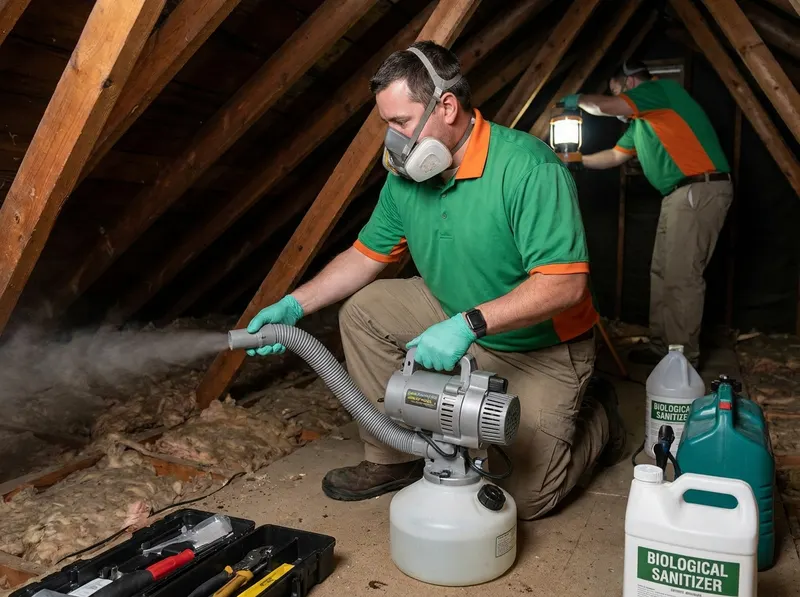
Pest activity inside enclosed framing generates immediate indoor air quality risks via stack effect ventilation, which pulls crawlspace and attic air upward into living areas. Attic and crawlspace biological sanitization targets the health threats left behind after animals have nested, which conventional chemical sprays cannot resolve. Rodent droppings and bat guano harbor fungal spores such as Histoplasma capsulatum alongside bacterial pathogens. This service removes dry feces using HEPA-filtered negative-pressure vacuums that capture particles down to 0.3 microns, preventing the redistribution of airborne contaminants across bedrooms and kitchens. Odor-masking deodorizers are bypassed in favor of broad-spectrum biocides that chemically break down lipid envelopes of viral agents and digest urine salts embedded in wood framing.
A single minor contamination zone requires localized clearance, whereas extensive nesting requires complete substrate stripping and mechanical exclusion. If animal droppings are restricted to a 10-foot boundary near an attic access hatch, spot extraction and targeted sanitization resolve the issue without disrupting surrounding insulation. If animal pathways run throughout blown-in cellulose or across exposed dirt crawlspaces, full clearing down to bare joists or subfloors becomes necessary. In these comprehensive cases, the trade-off involves higher upfront material replacement costs to eliminate the pheromone scent signatures that consistently pull new pests into the building envelope.
Historic masonry and timber structures across Detroit present distinct environmental contamination patterns. In neighborhoods like Boston-Edison, Indian Village, and Palmer Woods, large unfinished attics with cedar shake underlayment and original stone foundations frequently shelter long-standing rodent or bat colonies, leaving bio-waste layered across ceiling plaster. In Corktown, Woodbridge, and Southwest Detroit, older pier-and-beam crawlspaces permit moisture intrusion that amplifies biological odors and accelerates mold propagation alongside animal urine. Homes in Rosedale Park and Midtown with balloon-frame construction require full-perimeter evaluation, as pest waste drops through open wall cavities from the roofline to the basement sill plate. All bio-waste materials are bagged in heavy-gauge 3-mil containment liners before transport to Wayne County municipal disposal facilities.
Every job gets a firm, written price after a free on-site visit.
Tell us about your attic and crawlspace biological sanitization job in Detroit and we'll send a clear, written quote, usually the same day.
 Orelvo Pest Prevention