Residential flea and tick yard and interior knockdown addresses concurrent outdoor harborage and indoor nesting cycles across Detroit properties. Older brick colonials and craftsman homes throughout Boston-Edison,…
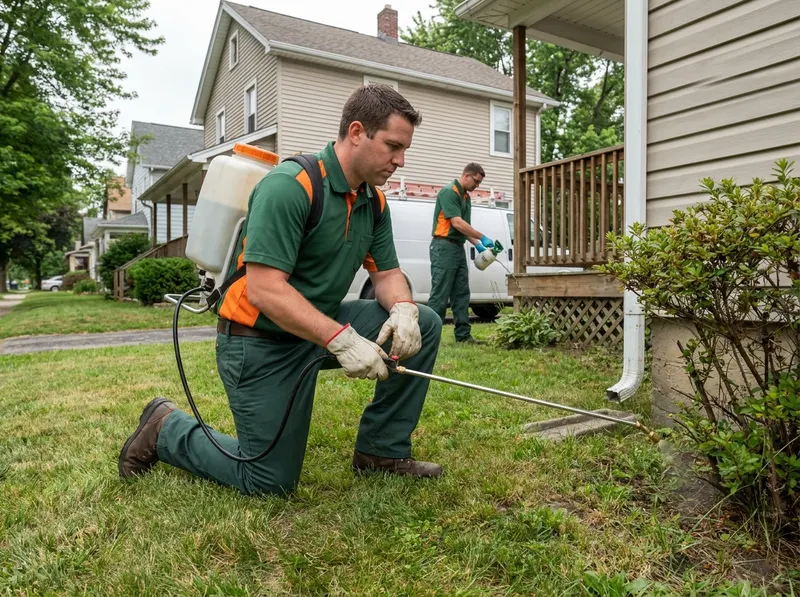
Residential flea and tick yard and interior knockdown addresses concurrent outdoor harborage and indoor nesting cycles across Detroit properties. Older brick colonials and craftsman homes throughout Boston-Edison, Palmer Woods, and Indian Village often feature dense canopy cover, shaded ivy, and foundational moisture that allow Ixodes scapularis (deer ticks) and Ctenocephalides felis (cat fleas) to proliferate undisturbed. Outdoor treatments apply 20 to 40 gallons of liquid residual barriers across lawns, groundcover, and vertical brush zones up to 3 feet high, directly halting questing ticks carried by urban wildlife along riverfront corridors and neighborhood alleyways. Inside the residence, technicians deploy low-odor adulticides paired with residual juvenile hormone mimics directly into floorboard gaps, beneath baseboards, and deep into carpet underlayment where 95% of flea populations exist as unseen eggs and larvae.
Selecting a combined interior and yard knockdown is recommended when pets exhibit repeated scratching or indoor flea counts exceed 5 specimens per room within 48 hours. When infestations are isolated strictly to outdoor perimeter grass near public easements or garden borders, an exterior-only barrier application prevents chemical exposure inside the dwelling, although it leaves carpet-dwelling eggs vulnerable to re-hatching after 14 days. The operational trade-off of a whole-property protocol is preparation time: occupants and household pets must vacate the home for 3 to 4 hours until interior surfaces dry, and thorough pre-treatment vacuuming is necessary to stimulate flea emergence from pupal cocoons before the chemical barrier bonds.
Properties in dense urban parcels such as Corktown, Woodbridge, and Midtown face elevated tick migration along detached fence borders and narrow side-lot corridors. For structural parcels in Southwest Detroit and Rosedale Park, lot sizes ranging from 0.10 to 0.35 acres dictate precise dosage calculations to safeguard neighborhood storm runoffs while maintaining a 60-day perimeter shield. The treatment sequence operates systematically: 1. Complete physical inspection of turf, crawlspace entries, and interior resting pads; 2. Dual-tank liquid barrier dispersal using 0.05% active suspension sprays outdoors; 3. Interior crack-and-crevice application of juvenile hormone disruptors; 4. Final baseline inspection confirming structural exclusion points and zero active surface moisture.
Every job gets a firm, written price after a free on-site visit.
Tell us about your flea and tick yard and interior knockdown job in Detroit and we'll send a clear, written quote, usually the same day.
 Orelvo Pest Prevention